


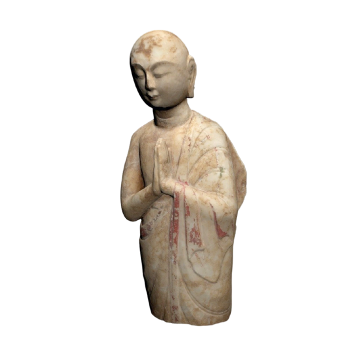
White White Jade Standing Arhat Statue
This is a Chinese Northern Qi period (550-577 AD) white marble standing arhat statue. According to art historians, such images of young monks are often considered to be Ananda (Ānanda), one of the ten disciples of the Buddha. The style of the statue dates back to the 6th century AD China's Northern Qi Dynasty, and the art of this period is known for its serene, introspective expressions and smooth lines of clothing. It has the classic "Oriental smile", reflecting the peak level of Buddhist art at that time. The statue is carved from high quality white marble.

Sitting Statues of Sakyamuni Buddha with Copper and Gold
This is a bronze gilt statue of Sakyamuni Buddha, with a typical Tibetan Buddhist art style. According to its gesture (seal), this Buddha statue can be identified as the master Sakyamuni Buddha. Statues are usually cast in copper or bronze and gilded on the surface. This movable gold and bronze Buddha statues were very popular in the Han and Tibetan areas of China and lasted until the Ming and Qing dynasties. The statue has a plump face, a serene look, regular screw hair, a right shoulder cassock, smooth clothing lines, and a double-layer lotus throne with a waist. This style combines the characteristics of statues in India, Nepal and the Central Plains, forming a unique Tibetan Buddhist art school.
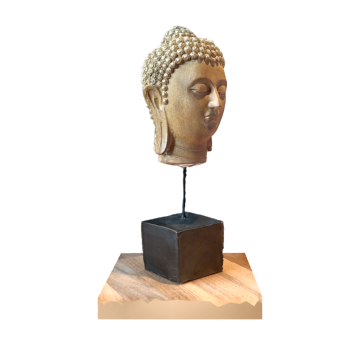
Buddha head ornaments
This is a Buddha's head ornament, commonly used in home decoration, designed to create a peaceful, Zen atmosphere. The sculpture depicts the head of Shakyamuni Buddha. It is characterized by slightly drooping eyes, a calm expression, elongated earlobes (symbolizing the abandonment of worldly wealth) and a spiral bun on the top of the head. It is installed on a simple black base with a natural wood grain square bottom under the base. The overall design combines classical Buddhist elements and modern minimalist style.

Buddha Head Statue of Sakyamuni, Founder of Buddhism
The statue depicts the head of Buddha Sakyamuni, the founder of Buddhism, with a meditative look, closed eyes, a bun on the top of the head (called "Ushnisha", symbolizing wisdom) and a spiral bun (called "snail hair").

Stone carving of Buddha's head (Thai dra mantle period)
This is an ancient stone Buddha head with a unique artistic style, and is usually identified as a work originating from the Dhara Mantdi (Mon-Dvaravati) period in Thailand, about the 7th to 8th centuries AD. It combines Indian archetypes and local aesthetics, and is an important representative of early Thai Buddhist art. The Buddha's head shows a serene, introspective look. The piece is carved from sand or limestone. As an ancient relic, it bears obvious traces of years and beautiful patina (patina), reflecting its long history.

Buddha
The image of Buddha. Generalized including Bodhisattva, Rohan, Ming Wang, and so on. Although there are two kinds of statues, sculptures and portraits (pictorial), only sculptures are called Buddha statues, while portraits are called images. In ancient India, it was believed that carving Buddha statues was a blasphemy, so ancient carvings such as Shanqi (Sanskrit ^ nchi ^) only symbolized Buddha with the marks of Buddhism, Bodhi tree, Buddha's footprints, etc. Later, with the rise of Mahayana Buddhism, the sculpture of Buddha began to prevail, so there are many records about the cause of the statue and its merits in the Mahayana classics.

Gandara relief sculpture
This is a Gandhara relief depicting a person riding between the two humps of a camel, holding a sacred object in both hands, with a solemn and sorrowful expression. The person in front turned around to look at the artifact, with the same serious expression on their face. This relief is from the Swat region in the third century AD and is made of gneiss. Gandara art is a Buddhist art form from the Gandara region in the northwest of the Indian subcontinent (now eastern Pakistan and Afghanistan), which reached its peak around the 1st century BC to the 5th century AD.

Ming Dynasty gilded bronze Buddha statue of Medicine Buddha
This Buddha statue is currently housed in the Santa Barbara Museum of Art in the United States. This Medicine Buddha statue can be traced back to the Ming Dynasty in the 16th or 17th century and was auctioned at Christie's in Paris in 2022.

Maitreya Buddha Stele
This is an artwork created in 563 AD and is currently housed in the Minneapolis Museum of Art in the United States. Although this work is relatively small in scale, its exquisite carvings showcase the complete image found on larger Buddha statues. In addition to the Maitreya statue in the center, the engraved halo, and the bodhisattvas on both sides, flying heavens and dragons also appear on the flame shaped mandalas at the top and bottom. The back of the stone tablet is engraved with a 69 character inscription, which records the name of the donor who commissioned the production of this work and dedicated it in 563.

The stone carved Buddha statue on the pagoda is located in Kathmandu, Nepal
The four Buddha statues carved on the pagoda are located in a temple in the Swayambunat complex in Kathmandu, the capital of Nepal, and were built in the 16th century. The architectural complex of Swayambunat includes a pagoda, various temples and shrines, as well as Tibetan monasteries, museums, and libraries.

Shanru Dragon King Stone Statue
Shanru Dragon King, also known as Shannu Dragon King, is one of the eight Dragon Kings in Japanese mythology - Rain God Dragon. According to legend, the monk Konghai brought about the appearance of the benevolent Dragon King during a famous rain seeking competition in 824 AD. This statue is located at Longquan Temple on Mount Daifeng in Japan.

Buddhist Gatekeeper Stone Statue
The statue of the gatekeeper god from the 8th century is now housed in the Minneapolis Museum of Art in the United States. This type of statue is usually located at the entrance of Buddhist cave sanctuaries and temple complexes, with the purpose of obstructing any forces opposing Buddhist thought. Therefore, they are vividly depicted as energetic postures, threatening facial expressions, exaggerated muscle structures, and ready to face all threats. The basic posture of this rare Tang Dynasty work, with its surrealism and complete plasticity, represents a style that had a huge impact on the Buddhist guardian image carved during the Kamakura period in Japan (1185-1333).

Bodhidharma statue
Bodhidharma was a Buddhist monk who lived in the 5th or 6th century. Traditionally, he is considered the successor of Zen Buddhism to China and is regarded as the first patriarch of China. According to Chinese legend, he also began physical training for Shaolin monks, leading to the birth of Shaolin Kung Fu. In Japan, he is called Damo. Regarding the artistic depiction of Bodhidharma, he is depicted in Buddhist art as a non Chinese with a hot temper, thick beard, and wide eyes. He is referred to as' blue eyed Hu 'in Zen texts.
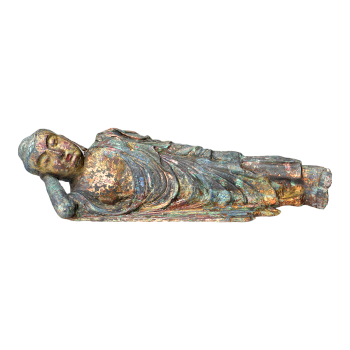
Nirvana Buddha statue
Nirvana Buddha is a Buddha statue depicting the Buddha's entry and death, also known as Sleeping Buddha, Sleeping Buddha, or Sleeping Buddha. It is manifested in the form of a Buddha statue depicting the appearance of Shakyamuni entering and disappearing.

The statue of King Vishnu
This model depicts Visravana, also known as the Heavenly King, in Japan. In Buddhism, the Bodhisattva Samantabhadra is one of the Four Heavenly Kings and is often depicted as a deity protecting Buddhism and the Buddhist world. This sculpture is currently located at the Guimet Museum in France.

Buddha's seated statue from the 2nd to 3rd century AD
This Buddha statue may have been made in the Gandhara region (now Pakistan) in the 2nd to 3rd century AD. The height of this Buddha statue is 95 centimeters, the width is 53 centimeters, and the diameter is 24 centimeters. This Buddha statue depicts the Buddha sitting and preaching. The Buddha's gesture is very special. This gesture, also known as the clay jar or the Dharma wheel, reveals that the Buddha is telling a sermon, explaining the four noble truths of human existence and the path to enlightenment. This statue is currently located in the British Museum.
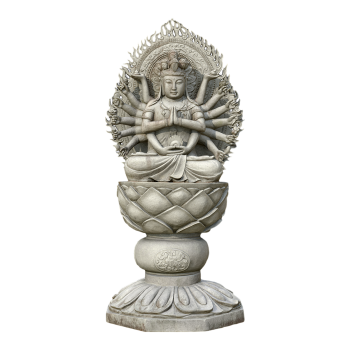
Thousand-Hand Guanyin Statues
Thousand-handed Guanyin is an image of Guanyin Bodhisattva in Buddhism, depicted as Guanyin Bodhisattva with many hands. Each pair has the power of the eyes to control everything, symbolizing the wisdom and compassion of Guanyin Bodhisattva. Avalokiteshest is widely depicted in Buddhist art, especially in temples and works of art in China, Japan, and other East Asian countries. This image is widely worshipped and believed, and is regarded as a symbol of saving all living beings and eliminating the suffering of all living beings.

12th Century Water Moon Guanyin Collected by Minneapolis Art Institute
The 12th century Water Moon Guanyin is an image of Guanyin Bodhisattva widely depicted in Buddhist art. It has its roots in the art of painting and sculpture during the Song Dynasty (960-1279 AD) in China. Water Moon Guanyin got its name because of the integration of water and moon elements in its image. Water Moon Guanyin usually has a water bottle on its head, symbolizing the state of purity and nirvana. Behind Guanyin Bodhisattva, a moon is often depicted, representing the light of wisdom and compassion.

Popular Models
Honey Badger (3D animated model)
192 View
Guinea fowl (3D animated model)
163 View
Wild Goose (3D animated model)
185 View
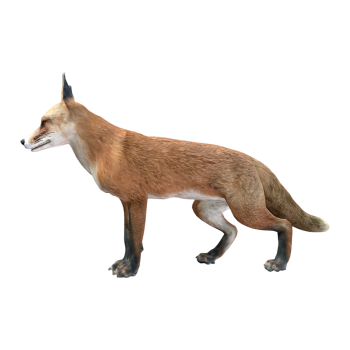
Red Fox (3D animated model)
153 View
Random Model
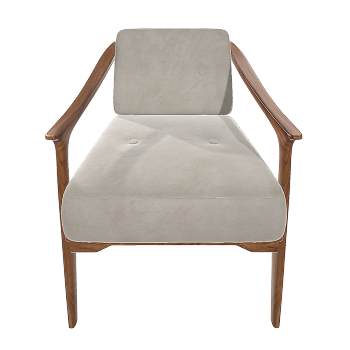
Chinese modern style wooden armchair
1073 View

Household dual-use ladder
1181 View

3D model animation of sausage dog
782 View
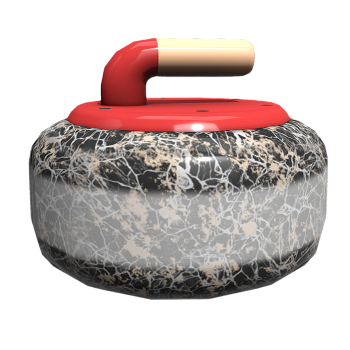
Competition Curling GLB Model
950 View

Pagani Huayra2020 Convertible
969 View


Buddha Handmelon 3D Model
949 View

Stem eye fly 3D animation model
744 View

INSMA wire cutting pliers
742 View
